
Braxton Property Values on the Assessment Record
One Braxton property record can hold several value figures. The assessment system shows cost and appraised amounts for land, building, and total. The deed filed with the County Clerk is the legal instrument behind a transfer. The state's Appraisal/Sales search may show a sale-price range. The detail card carries no last-sale field. For the exact conveyance, the deed records are the right source.
| Value | What It Is | Where |
|---|---|---|
| Assessed value | Value used in the assessment and tax system after the state's assessment level is applied. | Braxton Assessor / WV assessment card |
| Appraised values | Land, building, and total estimates shown in the detail card. | WV Property Assessment detail |
| Market value | True or market value used as the basis for the state assessment rule. | Assessor valuation process; not a sale quote |
| Last sale price | Consideration stated by a sale record, when available. | Recorded deed; assessment sales fields may add context |
West Virginia law sets the assessment level statewide. The level is sixty percent of true or market value. So an assessed figure will not match a private sale price. A recorded price reflects a single transaction, with its own date and terms. The assessment, by contrast, is a mass-appraisal record meant for taxation. The state search does offer sale-date and price filters. Not every card, however, displays the latest consideration for the parcel.
What a Braxton Property Value Card Displays
The sample detail shows Cost Values and Appraised Values. Each is grouped into land, building, and total fields. A building card may also list year built, stories, architectural style, exterior wall, and basement type. Floor area and building value may appear too. These characteristics explain how the estimate was built. They are not a private appraisal report or a forecast of a future sale price. The WV assessment detail example shows the field layout on the official card.
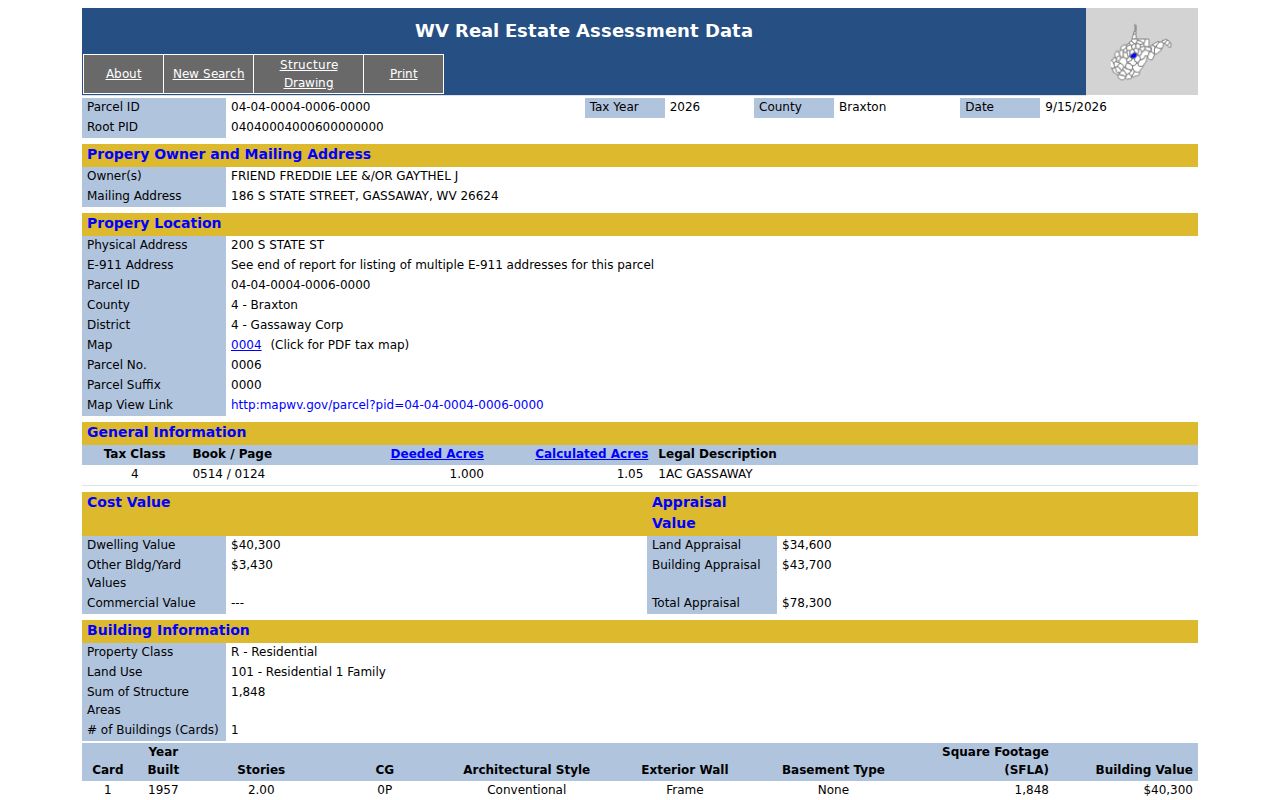
Read the land and building components separately before comparing the total with another property.
Braxton Property Value Uses a 60 Percent Level
West Virginia's ad valorem system assesses property at sixty percent of true or market value. The assessor studies market evidence carefully. Still, the assessment exists for the tax system. It is not a realtor's list price. It is not an offer, a lender's appraisal, or a buyer's closing figure.
The assessment search exposes minimum and maximum ranges for land, building, and total appraisal. It also separates calculated acres from deeded acres. Sale-date and price filters are available too. Comparisons work best when property class, location, and building characteristics are alike. Read the assessment data with the year printed on the card. Never treat it as a live quote. The Braxton Assessor's valuation guidance describes the local record and reappraisal approach.
Use the county's current information to interpret a value or ask about a correction.
Looking Up a Braxton Property Value
Start at the WV Property Assessment Search and pick Braxton County. Search by Street Name, Owner Name, or parcel number parts, then open the matching card. Check the assessment year, land value, and building value. Read the total appraised field, plus any sale or acreage data. Need a price that was actually recorded? Follow the card's deed reference to the County Clerk's instrument.
- Search the property by street or parcel ID and verify the result's district and legal description.
- Read the land, building, and total cost or appraised fields with their assessment year.
- Use Appraisal/Sales filters for sale-date and price ranges, but confirm a specific transfer in the recorded deed.
- Compare only parcels with similar class, use, size, and building details.
- Assessed value
- The figure used in the property-tax assessment after the state's ratio is applied.
- Market value
- An estimate of true value based on market evidence, not a guaranteed sale amount.
- Assessment level
- The general relationship between assessed value and true or market value.
- Sale consideration
- The amount reported for a conveyance, which must be checked in the deed record.
- Reappraisal
- The assessor's periodic review of property data and valuation.
Braxton Property Values Change Through the July Cycle
Braxton's assessment date falls on July 1 each year. The county assessor visits property on a continuous three-year reappraisal cycle. Additions, renovations, demolition, nearby sales, and construction costs can all shift an estimate. A parcel may therefore carry a different land or building value in a later roll. This can happen without any new sale.
The statewide data comes out annually. Simple ownership changes may lag in the viewer. New parcel lines can take longer still. Compare two values using the year printed on the assessment record. The assessor publishes no Braxton-only revaluation study, and no recent town-specific trend is available.
Braxton Gas and Royalty Interests Use Separate Books
Braxton's assessor offers an unusual resource-interest detail. Royalty interests sit on real-property books, while working interests are listed on personal-property books. The value method can draw on production and income data. The assessor describes local royalty appraised value as often two to five times one year's income. Treat that as an assessment approach only. It is no guarantee for a specific interest or a current market price.
A surface parcel card can fall short on a mineral or royalty question. The WV Property Viewer does not display mineral parcels. A surface GIS polygon is not the same record as an oil or gas interest. Ask the Assessor which book applies. Check the recorded instrument for the legal rights conveyed.
Braxton Exemptions Change Taxable Amounts
An exemption can change the amount used to compute a tax bill. It does not touch the market value or sale price of the land. The statewide list includes a $20,000 homestead exemption for seniors and disabled residents, subject to eligibility and application rules. Before comparing taxable amounts, confirm that an exemption actually sits on the Braxton card. Also confirm that the claimant qualifies.
The assessment search has an Exemptions area in the parcel record. Details and current forms should come from the Assessor. Bill lookup, tax payment, and appeals rely on separate records, covered on the Braxton property-tax page.
Braxton Sale Prices Need the Recorded Deed
The assessment search lets you filter by sale date and price range. The detail card may not show the last consideration amount, though. For that figure, go to the recorded conveyance held by the County Clerk. Also note that a transfer excise tax under West Virginia law is not the purchase price, and it never turns the assessor's total into a market appraisal of the parcel.
What a Braxton Property Value Is Not
A Braxton assessed value will not tell you what a house will sell for. It is not an appraisal, either. Only a licensed appraiser can deliver that kind of number. The assessor's figure follows a statewide tax rule, a fixed valuation date, and an annual update cycle. So it can sit far from any negotiated price. In the same way, a GIS acreage figure or a parcel line on the map proves nothing about value or legal boundary.
Value vs price. An assessment is a tax record, not an appraisal for a purchase or sale. Use a qualified appraiser for a current market opinion.